
Dental Hygienist in Hove: What to Expect at Your Visit

Updated: Jun 25
Most people know they should see a dental hygienist. Not everyone does. And if it has been a while, it is easy to feel like you have missed the window, or that the appointment will be awkward, or that the hygienist will have something to say about how long you have left it.
None of that should put you off.
This guide is for anyone in Hove or Brighton who wants to know what a hygiene appointment actually involves, who needs one, and what to expect when they get there. No jargon, no pressure, no lecture about flossing.
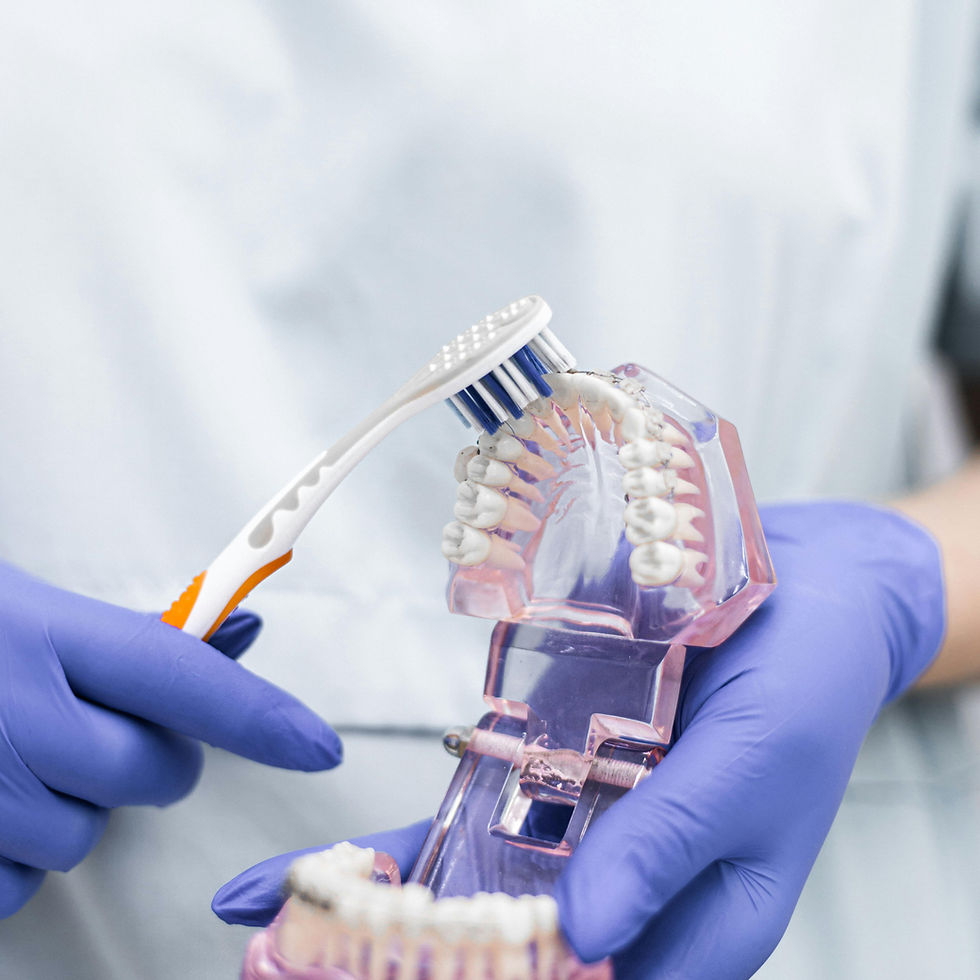
What does a dental hygienist actually do?
A dental hygienist is a separately qualified oral health professional. Their focus is on your gums and the cleanliness of your teeth, which is a different job from your dentist's. Your dentist checks the condition of your teeth, looks for decay, and identifies anything that needs treatment. Your hygienist deals with what builds up on your teeth between visits and what your toothbrush cannot shift on its own.
That buildup comes in two forms. Plaque is the soft, sticky film that forms on teeth every day. Regular brushing removes most of it. Tartar, sometimes called calculus, is what plaque becomes when it is not fully removed and hardens against the tooth surface over time. Once tartar forms, brushing cannot touch it. Only professional instruments can.
Tartar sitting against the gumline causes the gum tissue to become inflamed. That inflammation is gum disease, and most adults have some degree of it without knowing, because the early stages do not hurt. The hygienist removes the buildup, reduces the bacterial load in your mouth, and then advises you on what to do differently at home to slow the whole process down.
The tools involved are less alarming than they sound. An ultrasonic scaler uses fine vibrations and a light water spray to break down tartar deposits. The sensation is more vibration than scraping. Hand instruments handle the detailed work around the gumline, where the scaler cannot reach as precisely. A polish at the end removes surface staining from tea, coffee, and daily use. It also leaves the tooth surface smoother, which actually slows down how quickly plaque reattaches. That is the whole appointment. Most patients find it straightforward once they know what to expect.
Does a hygiene appointment hurt?
This is what most people actually want to know before they book, so it is worth being direct about it.
For most patients, no. Some people feel sensitivity around the gumline during the scale, particularly if it has been a while or if the gums are inflamed. That sensitivity is usually mild and short-lived. It does not linger.
The main reason hygiene appointments can be uncomfortable is gum inflammation. Inflamed gums are more sensitive than healthy ones. The good news is that this tends to improve significantly after a few regular appointments, as the gum tissue responds to treatment and settles down. Patients who find their first visit uncomfortable after a long gap often notice that subsequent visits are a different experience entirely.
If you are nervous, say so before the appointment starts. The hygienist can adjust their approach, take more breaks, and work at a pace that suits you. There is no reason to sit in silence if something is uncomfortable.
What happens at a hygiene appointment in Hove?
A hygiene appointment at Somerhill Smiles on Church Road follows a clear and predictable sequence. Here is what to expect.
The hygienist starts with a brief assessment of your gums and teeth, looking for signs of inflammation, any pocketing around the gumline, and areas where buildup has concentrated.
The scale comes next. The ultrasonic scaler removes the bulk of any tartar deposits from the tooth surface and just below the gumline. Hand instruments are used for the more detailed work in tighter spaces.
A polish removes the surface staining. Tea, coffee, and general daily use all leave a residue on tooth enamel that the polish clears away. Your teeth feel noticeably clean and smooth by the end.
The hygienist finishes with personalised advice based on what they found. That might cover brushing technique, whether interdental brushes or floss would suit your teeth better, or anything specific to your gum health.
Most appointments take between 30 and 45 minutes. Your teeth may feel slightly sensitive to temperature for a day or so afterwards, particularly if there was significant buildup to clear. This is normal and passes quickly.
If you want to understand the difference between this and a routine dental check-up, the guide to what a dental check-up includes covers that clearly.
Who needs to see a dental hygienist?
The straightforward answer is almost everyone. Hygiene appointments are not reserved for people with gum disease or obvious problems. They are routine preventive care, the same way a check-up is routine. You do not wait for a tooth to hurt before you see a dentist. The same principle applies here.
That said, some groups benefit more urgently than others.
People with gum disease or a history of gum problems. If your gums bleed when you brush or if you have been told in the past that you have gum disease, regular hygiene appointments are not optional. Gum disease is progressive. It does not resolve without treatment.
People with fixed braces, implants, or bridges. These create areas that are genuinely difficult to keep clean at home. Tartar accumulates faster around orthodontic brackets and implant margins, and professional cleaning is the reliable way to manage it.
People who smoke. Smoking increases gum disease risk significantly and can suppress the bleeding that usually signals inflammation, which means problems can develop further before they are noticed.
People who have not had a clean in a long time. Two years, five years, longer: it does not matter. The hygienist is not there to comment on the gap. They are there to help you from wherever you are starting, and the sooner you go, the sooner the situation improves.
You can find out more about our full range of preventive treatments on the general dentistry page.
How often should you see a hygienist?
Every six months is the standard recommendation for most people. It lines up with the typical check-up schedule, so booking both together means you are keeping your oral health consistent without adding extra visits.
Some patients need to go more frequently. If you have active gum disease, a history of periodontal treatment, or your tartar builds up quickly, your dentist or hygienist may suggest every three or four months. This is not a sign that something is seriously wrong. It means your gum health needs closer monitoring for a period, and more frequent appointments keep it from backsliding.
The consequence of skipping is straightforward: tartar accumulates in places brushing cannot reach, gum inflammation continues, and any problems that develop become more involved to treat. Early-stage gum disease is managed with a scale and polish.
Advanced gum disease requires deeper treatment below the gumline, more appointments, and longer to resolve. The gap between those two outcomes is often simply a matter of whether someone attended regularly or not. Consistent, routine hygiene appointments are considerably preferable to longer gaps followed by more intensive treatment.
Hygiene appointments at Somerhill Smiles
Somerhill Smiles on Church Road offers dental hygiene appointments in Hove and Brighton for both registered patients and new patients. Appointments are with a qualified dental hygienist and are set up to be unhurried.
If you have not been for a while, that is fine. The practice does not operate on the assumption that patients should already have everything sorted. You book, you come in, the hygienist works with what is there. The first appointment after a long gap may take a little longer than a routine visit, simply because there is more to clear. That is normal. After that, regular appointments are quicker and more straightforward.
One practical thing worth knowing: the membership plan at Somerhill Smiles covers your hygiene appointments as part of the monthly fee. For a £21/month plan, you get your routine check-ups and hygiene visits included, plus a discount on any treatment you need. If you attend regularly, it works out to a straightforward saving. Full details are on the plans and fees page.
Conclusion and Next Steps
Regular hygiene appointments are one of the more straightforward things you can do for long-term oral health. They remove what your toothbrush cannot reach, catch gum problems before they develop into something more serious, and leave your teeth feeling properly clean. For most people, every six months is the right frequency. If it has been longer than that, the right move is simply to book. Following your dental hygiene appointment, you may wish to enhance your smile further with our professional teeth whitening treatments, designed to safely and effectively brighten your teeth for a more confident smile.
You can book your hygiene appointment at Somerhill Smiles in Hove online, or get in touch if you have questions before you do.


Comments